Evaluating event vendors comes down to six factors: experience, execution capability, pricing transparency, risk management, references, and past performance. This guide walks procurement and HR teams through a repeatable vendor selection process, a weighted scorecard, and the mistakes that quietly inflate event budgets. Use it to shortlist vendors with evidence instead of guesswork.
When a procurement team sits down to compare event proposals, the stakes go well past décor and stage design. A vendor who overpromises on capacity or underdelivers on execution can blow the budget, miss a hard deadline, or leave leadership fielding awkward questions in front of a room full of stakeholders. That’s why more organizations now treat event vendor evaluation as a formal procurement exercise instead of a gut-feel decision made off three quotes in a spreadsheet.
Procurement is also simply more involved than it used to be. Gartner’s 2026 research found that procurement professionals now act as decision-makers in 53% of business buying cycles, shaping requirements from the start rather than just signing off at the end. Gartner Event sourcing is following the same path: structured scorecards, reference checks, and documented vendor selection criteria instead of a handshake based on a good pitch deck.
This guide breaks down how procurement and HR teams actually evaluate event vendors: the criteria that carry real weight, a seven-step process you can reuse for any RFP, and the mistakes that cost the most once a contract is signed.
How Do Procurement Teams Evaluate Event Vendors?
Quick Answer: Procurement teams typically evaluate event vendors across six factors: proven experience, execution capability, pricing transparency, risk management, references, and past performance. The goal isn’t the lowest quote. It’s the vendor most likely to deliver the event without surprises, rework, or last-minute substitutions.
In practice, this means moving past the proposal document itself. A polished PDF says very little about how a vendor behaves three weeks before an event, when a venue changes its terms or a speaker cancels. Strong evaluation processes ask for evidence: past event photos and videos, named references from similar-sized events, and a clear explanation of who does what once the contract is signed. Organizations that want true single-vendor accountability rather than a patchwork of subcontractors tend to ask this question earliest in the process, because it changes how every other criterion gets scored.
Why Is Choosing the Wrong Event Vendor Expensive?
Quick Answer: A weak vendor rarely fails outright. It shows up as cost creep, missed timelines, and last-minute scrambling that stakeholders remember long after the event ends. Industry data puts avoidable overspend from poor vendor and venue decisions at 20 to 40 percent above the original budget.
Most of that overspend doesn’t come from one dramatic failure. It comes from small gaps that compound: a venue that needed extra rentals nobody budgeted for, a vendor who quietly subcontracted production to a third party, or a proposal that looked complete but left out permits, insurance, or contingency coverage. SPIN research on corporate event planning found that rushed decisions and price-only comparisons are consistently behind these overruns.
Risk transfer is one of the more overlooked tools procurement teams have here. Building performance clauses into the contract, tied to a defined portion of the potential loss if a vendor fails to deliver, shifts some of that financial exposure back onto the supplier instead of leaving the client to absorb it. Event risk management research This is exactly the kind of clause a strong risk management process should surface before signing, not after something goes wrong. Aramm Events builds this thinking into every proposal through structured risk management and contingency planning, so procurement isn’t the one absorbing the cost of a surprise.
What Criteria Do Procurement Teams Use to Evaluate Event Vendors?
Quick Answer: The strongest procurement evaluations judge event vendors on total cost of ownership, quality systems, delivery performance, financial stability, compliance, and past execution, not on the headline quote alone. Leading procurement bodies including the Institute for Supply Management, Gartner, and Deloitte all point in the same direction: evaluate suppliers beyond unit price.
Six criteria tend to carry the most weight in an event context:
- Experience and track record. Has the vendor handled events of a comparable scale, industry, and complexity, including any regulatory or protocol requirements?
- Execution capability. Does the team have the depth to run the event end to end, or does the proposal depend on subcontractors the client never gets to vet?
- Pricing transparency. Is the budget broken down clearly, or does it bundle vague line items that leave room for surprise add-ons later?
- Risk management and compliance. Does the vendor carry insurance, hold the right permits, and have a documented contingency process?
- References and past performance. Can the vendor connect procurement with two or three clients who ran a similar event, not just a highlight reel?
- Creative and cultural fit. Does the vendor’s design sensibility match the brand, or will procurement be negotiating creative direction from scratch?
ISM’s supplier evaluation guidance frames this well for procurement audiences: leading teams assess total cost of ownership, quality systems, delivery performance, and financial stability well before they compare prices line by line. For a deeper look at what a strong proposal should actually contain, Aramm Events’ guide on how to choose the best corporate event management company in Chennai walks through each of these in more depth.
How Do Procurement Teams Verify an Event Vendor’s Execution Capability?
Quick Answer: Procurement teams verify execution capability by requesting named references from similar-sized events, reviewing documented case studies rather than marketing highlight reels, and confirming who on the vendor’s team will actually be on-site during setup and execution, not just who signs the contract.
A proposal can promise anything. What separates a vendor procurement can trust is proof that they’ve delivered under real constraints before, tight timelines, protocol-heavy government events, or multi-location logistics that don’t leave room for error. Aramm Events, for instance, has managed Ministry of Defence Foundation Day programs, Parliamentary Committee hospitality and logistics, and plant inauguration ceremonies for manufacturing clients near Oragadam and Arakkonam. That kind of portfolio tells procurement more about execution capability than any pitch deck can. A full breakdown of what a capable vendor should offer end to end is covered in Aramm’s guide to services you should expect from a corporate event management company.
The 7-Step Event Vendor Evaluation Process
Competitors usually stop at a checklist of criteria. Procurement teams that want a repeatable, defensible decision use this structured, seven-step process instead. Here’s the one we recommend to HR and admin teams building their first formal vendor selection process.
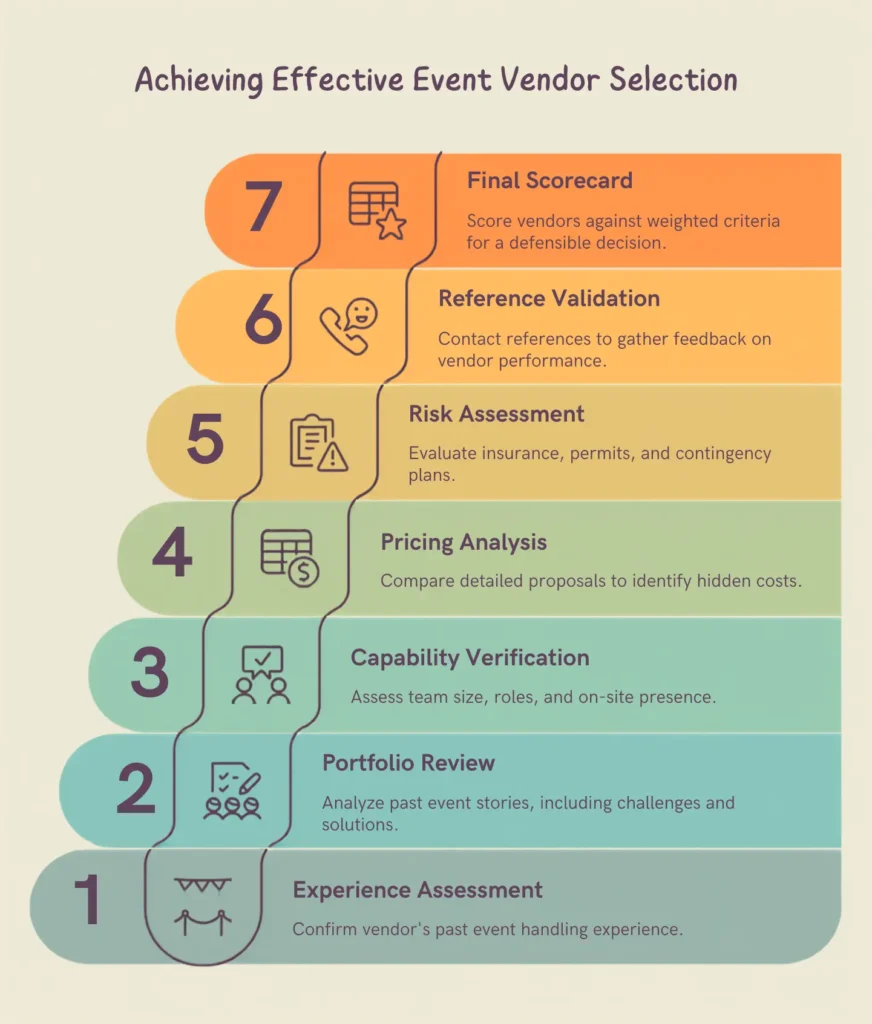
Step 1: Experience Assessment. Confirm the vendor has handled events of a similar scale and category before, and ask for specifics, not general claims.
Step 2: Portfolio Review. Look past polished photos. Ask for the story behind two or three past events, including what went wrong and how the team handled it.
Step 3: Capability Verification. Confirm team size, in-house versus subcontracted roles, and whether the same team that pitches the proposal is the one that shows up on event day.
Step 4: Pricing Analysis. Compare proposals line by line, not total to total. A detailed corporate event budget planning breakdown makes hidden costs visible before they become change orders.
Step 5: Risk Assessment. Check insurance coverage, permit-handling experience, and whether the vendor has a documented contingency plan for common failure points like vendor no-shows or venue changes.
Step 6: Reference Validation. Call the references. Ask what the vendor got wrong and how they fixed it, not just whether the client was satisfied.
Step 7: Final Scorecard. Score every vendor against the same weighted criteria so the decision is defensible to finance, leadership, and audit, not just a preference call.
Event Vendor Evaluation Scorecard
| Criteria | Weight | What Procurement Should Look For |
| Experience | 25% | Comparable event scale, industry exposure, protocol or regulatory history |
| Reliability | 25% | On-time delivery history, contingency planning, insurance and compliance |
| Pricing | 15% | Transparent, itemized proposals with no hidden line items |
| Creativity | 15% | Design sensibility and brand alignment across past work |
| Team Capability | 10% | Depth of in-house team versus reliance on subcontractors |
| References | 10% | Verified feedback from clients with comparable events |
A scorecard like this turns vendor comparison into a documented, weighted decision instead of a subjective preference. Weight the categories to match what matters most for your event. A government protocol event might weight reliability and compliance higher; a product launch might weight creativity higher.
Expert Insight
Most procurement teams focus their comparison on the bottom line of a quote. In practice, the real cost differences show up after the contract is signed: change orders, quietly substituted subcontractors, and “final” quotes that grow once the event date gets close. A vendor’s pricing structure tells you less about total cost than their track record for sticking to it.
What We’ve Learned Reviewing Vendor Evaluations Across Chennai
What we have observed: Procurement and admin teams across Chennai increasingly ask for the same three things before shortlisting an event vendor: a named point of contact for the full event lifecycle, proof of experience with events of comparable scale, and a straight answer on what happens if something goes wrong three days before the event. Teams that have run events from 50-guest leadership meetings to programs with 6,500-plus participants tend to answer all three without hesitation, because the process has already been tested at scale.
What we learned: The vendors who score well on paper are not always the ones who perform well on-site. A scorecard weighted toward reliability and references, not just pricing and creative pitch quality, does a better job predicting how event day will actually go.
Our recommendation: Build the scorecard before requesting proposals, not after. It keeps the evaluation objective and gives procurement a clear answer when leadership asks why one vendor was chosen over another.
What Mistakes Do Procurement Teams Make When Selecting Event Vendors?
Quick Answer: The most common mistakes are comparing vendors on price alone, skipping reference checks, accepting a proposal without a contingency clause, mistaking a strong creative pitch for proven execution, and splitting the event across multiple vendors instead of one accountable partner.
- Choosing based only on price. The lowest quote often excludes line items that reappear later as change orders.
- Ignoring the execution process. A great creative concept means little if the team behind it has never run an event at this scale.
- Skipping reference checks. A polished proposal can hide a track record of missed deadlines that a five-minute reference call would catch.
- Not assessing risk planning. Proposals without insurance details, permit experience, or a contingency plan shift all the risk onto the client.
- Fragmenting the vendor list. Hiring separate vendors for décor, AV, and logistics multiplies coordination points and makes it harder to hold anyone accountable when something slips.
That last point is why single-vendor accountability keeps coming up as a deciding factor once teams have compared a few proposals side by side. Aramm’s roundup of top event organizers in Chennai covers what separates a fragmented vendor list from one accountable team.
How Should Procurement Teams Shortlist Event Vendors?
Quick Answer: Shortlist event vendors by defining objectives first, building a weighted scorecard before requesting proposals, scoring every vendor against the same criteria, and validating the top two or three with reference calls before making a final decision.
Step 1: Define event objectives and budget range. Procurement can’t score vendors fairly without knowing what the event actually needs to achieve.
Step 2: Create a vendor requirements document. List must-haves versus nice-to-haves, including scale, location expertise, and any regulatory or protocol requirements.
Step 3: Request proposals from a focused shortlist. Three to five vendors is usually enough to compare meaningfully without the process dragging on for weeks. Aramm’s guide on 10 questions to ask before planning your next corporate event is a useful starting point for building that requirements list.
Step 4: Score every vendor against the same scorecard. Consistency here is what makes the decision defensible later.
Step 5: Conduct a final review with references. Before signing, validate the top choice with at least two client references from comparable events.
Evaluating event vendors doesn’t need to be a guessing game, and it shouldn’t be decided on price alone. A weighted scorecard, a documented process, and a handful of honest reference calls will tell procurement more about a vendor than any proposal deck. The teams that get this right treat vendor evaluation as a repeatable process, not a one-off decision made under deadline pressure.
Aramm Events has been on the other side of this evaluation process for organizations ranging from manufacturing plants to Ministry of Defence programs, and single-vendor accountability tends to be the detail that matters most once an event is underway. See why procurement and HR teams across Chennai keep shortlisting the same partner in Aramm’s roundup of what sets it apart, or talk to our event experts about what a transparent, scorecard-backed proposal looks like.
Frequently Asked Questions
What is event vendor evaluation and why does it matter for corporate events?
Event vendor evaluation is the structured process procurement teams use to compare event vendors on experience, capability, pricing, and risk before signing a contract. It matters because the wrong vendor rarely fails outright. It shows up later as budget overruns, missed timelines, and stakeholder frustration that a documented evaluation process catches early.
What criteria do procurement teams use to evaluate event vendors?
Most procurement teams score vendors on six criteria: experience, execution capability, pricing transparency, risk management, references, and creative fit. Weighting these consistently across every vendor is what makes the decision defensible to finance and leadership.
How long does an event vendor evaluation process usually take?
For most corporate events, a structured evaluation from requirements document to final selection takes two to four weeks. Government or protocol-heavy events with more compliance checks can take longer, so it’s worth starting the vendor selection process well before the event date is locked.
What is a vendor scorecard, and how is it used in event vendor evaluation?
A vendor scorecard assigns a weight to each evaluation criterion, such as experience, pricing, and reliability, and scores every vendor against the same scale. It turns a subjective preference into a documented, comparable decision that procurement can defend later.
How many event vendors should be included in a shortlist?
Three to five vendors is usually the right range. Fewer than three limits real comparison, while more than five slows the process down without meaningfully improving the decision.
What red flags should procurement watch for when evaluating event vendors?
Watch for vendors who can’t share a verifiable portfolio, quote unusually low prices with vague line items, are slow or vague in early communication, or can’t clearly explain who handles what once the contract is signed.
Should procurement always choose the lowest-priced event vendor?
No. The lowest quote often excludes line items that resurface as change orders once planning is underway. A transparent, itemized proposal is a better predictor of total cost than the headline number.
What is single-vendor accountability, and why does it matter in vendor evaluation?
Single-vendor accountability means one team manages concept, vendor coordination, logistics, and execution under one contract, instead of the client managing separate vendors for décor, AV, and logistics. It removes the coordination gaps that cause delays and makes it clear who is responsible when something needs to change.
What should be included in an event vendor’s pricing proposal?
A strong proposal itemizes every cost category, venue, production, décor, hospitality, and contingency, rather than presenting a single bundled figure. Itemized pricing is what lets procurement compare vendors fairly and spot hidden costs early.
Has Aramm Events worked with government or highly regulated organizations before?
Yes. Aramm Events has managed programs including a Ministry of Defence Foundation Day, Parliamentary Committee hospitality and logistics, and factory and plant inauguration ceremonies for manufacturing clients, alongside corporate events ranging from 50-guest meetings to programs with more than 6,500 participants.