Table of Contents
A corporate event should do more than fill a venue or provide a good meal. It should help your business build stronger teams, create qualified leads, improve brand trust, or support revenue growth.
That is why corporate event ROI measurement matters. It helps HR, sales, marketing, and leadership teams see what the event achieved after the lights go down.
A well-planned event has clear goals, reliable data, and a simple report. When you measure the right results, you can confidently decide what to repeat, improve, or stop.
At Aramm Events, we believe every event should have a purpose. As experienced event organizers in Chennai, we help businesses plan corporate events that are creative, smooth, and measurable from concept to completion.
The best event is not only remembered by attendees; it is also supported by clear business results.
What Is Corporate Event ROI Measurement?
Corporate event ROI measurement is the process of comparing what your business gained from an event against what it spent. It helps you understand whether the event created real value for employees, customers, prospects, partners, or the brand.
The basic ROI formula is simple:
For example, if an event costs ₹5 lakh and brings ₹8 lakh in confirmed profit, the ROI is 60%. However, not every event should be judged only by immediate sales.
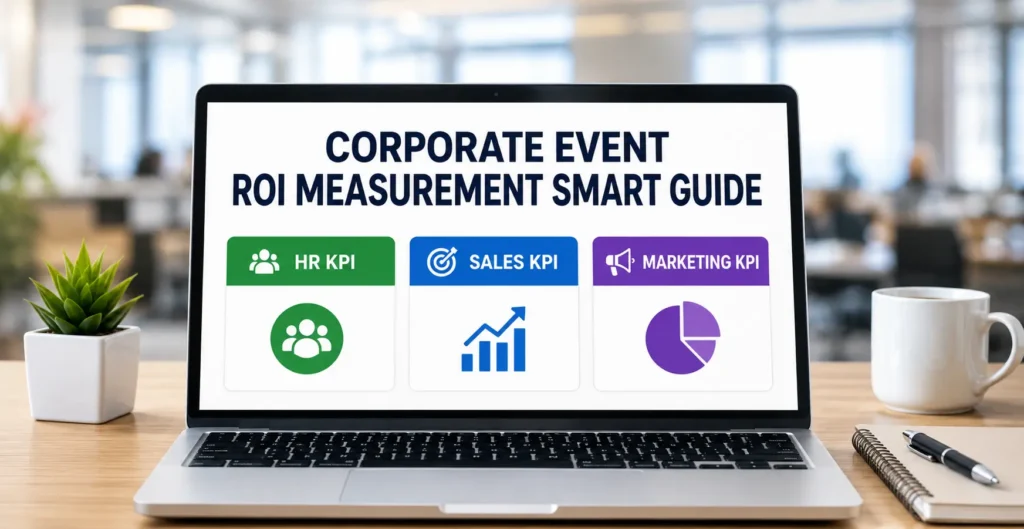
A leadership town hall may improve employee clarity. A family day may strengthen morale. A product launch may create leads that take months to become customers.
That is why the right event ROI KPIs depend on the event goal. Industry event platforms also recommend connecting attendee activity, feedback, engagement, and CRM data to wider business reporting rather than relying only on satisfaction scores.
Set Goals Before Event Planning
You cannot measure success if the goal is unclear. Before booking a venue, approving décor, or sending invitations, decide what success should look like.
Use one main goal and two or three supporting goals. This keeps your event team focused and prevents a confusing post-event report.
| Event Type | Main Business Goal | Example KPI |
|---|---|---|
| Annual day | Improve employee engagement | Employee satisfaction score |
| Sales meet | Build pipeline and close opportunities | Qualified leads and pipeline value |
| Product launch | Create awareness and demand | Registrations, media mentions, demo requests |
| Dealer meet | Improve partner relationships | Dealer attendance and follow-up meetings |
| Leadership town hall | Improve communication and alignment | Employee understanding score |
| Family day | Strengthen culture and retention | Participation and feedback score |
For example, a company may host a 500-person annual day. Its goal is not “to conduct a grand event.” Its goal may be to improve employee pride, recognise top performers, and increase participation across departments.
A clear business goal turns a corporate event from an expense into a measurable business activity.
Before the event, agree on the target numbers with HR, sales, marketing, and leadership. This avoids arguments after the event about what “success” means.
For a stress-free start, use this corporate event checklist in Chennai to align goals, budgets, responsibilities, vendors, and timelines before execution.
Corporate Event KPIs for HR Teams
HR teams often use events to improve employee connection, workplace culture, recognition, learning, and retention. These benefits may not show up as instant revenue, but they are still important business outcomes.
The best HR event metrics show whether employees attended, engaged, learned, and felt valued. Use simple surveys before and after the event to compare the change.
| HR KPI | How to Measure It | Why It Matters |
|---|---|---|
| Attendance rate | Attendees divided by invited employees | Shows interest and accessibility |
| Participation rate | People who joined activities, polls, games, or sessions | Shows active engagement |
| Employee satisfaction | Post-event survey score out of 5 or 10 | Measures event experience |
| Net Promoter Score | “How likely are you to recommend this event?” | Shows overall advocacy |
| Recognition reach | Employees who received or saw recognition | Supports appreciation culture |
| Learning score | Quiz, poll, or self-rated learning outcome | Useful for training and town halls |
| Retention signal | Compare engagement or exit feedback over time | Supports long-term HR review |
Ask simple questions such as: “Did you feel included?” “Did the event help you understand company goals?” and “What should we improve next time?”
Do not send a long survey with 25 questions. A five-question survey often gets more responses and clearer answers.
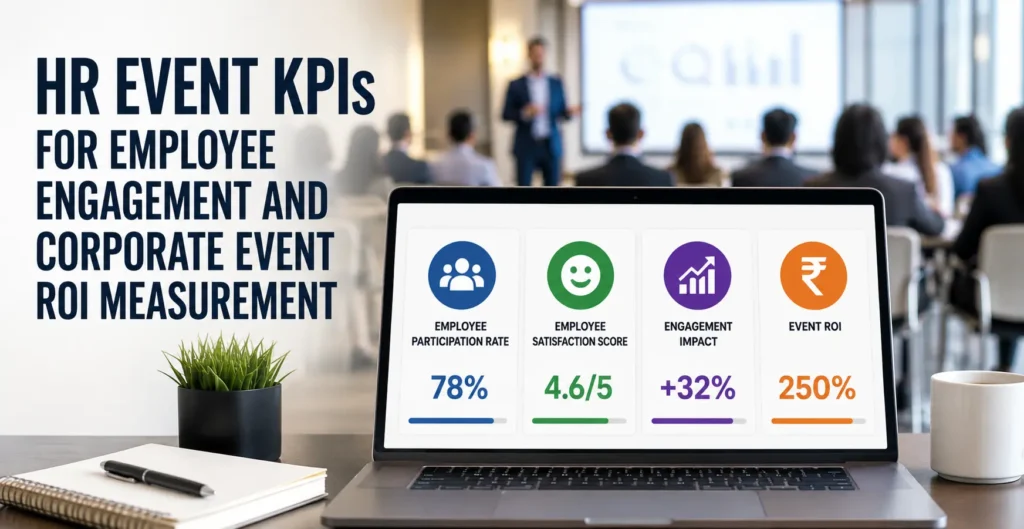
For a family day or employee celebration, compare attendance with the invitation count. Also track how many family members joined, activity participation, photo booth usage, and feedback from employees.
If employees feel seen, informed, and connected, the event has created value beyond one day.
Aramm Events plans employee experiences with practical engagement points, clear guest flow, family-friendly activities, and dependable event-day coordination. Explore our employee and family engagement event services when you want every detail to support your people goals.
Sales KPIs for Event ROI
Sales teams need proof that an event helped create meetings, opportunities, pipeline, or revenue. For a dealer meet, client conference, exhibition, or product launch, this means tracking contacts from registration through follow-up.
The most useful sales event ROI metrics connect event attendance to the CRM. A badge scan or business card alone is not a qualified lead.
| Sales KPI | How to Measure It | Good Practice |
|---|---|---|
| Leads captured | Total contacts collected | Record source as the event name |
| Qualified leads | Leads that meet your agreed criteria | Let sales define “qualified” |
| Meetings booked | One-to-one meetings during or after the event | Track meeting outcome |
| Opportunity value | Potential value of sales opportunities | Link to CRM records |
| Pipeline created | Value of opportunities influenced by the event | Review within 30 to 90 days |
| Deals closed | Revenue from converted event leads | Use a clear attribution rule |
| Cost per lead | Total event cost divided by leads | Compare with other channels |
| Cost per opportunity | Total event cost divided by qualified opportunities | Shows lead quality |
For example, imagine your B2B conference costs ₹8 lakh. You generate 120 leads, 30 qualified opportunities, and ₹40 lakh in sales pipeline.
The event may not close every deal immediately. Still, it gives your sales team a strong reason to follow up quickly and consistently.
Speed matters: a quality event lead can become cold if follow-up takes too long.
Set a service-level agreement before the event. For example, sales should contact hot leads within 24 hours and all qualified leads within three working days.
Event data can support stronger revenue reporting when attendee actions and event records are connected to CRM and marketing systems.
Marketing KPIs for Event ROI
Marketing teams often own brand awareness, registrations, campaign reach, audience engagement, and lead nurturing. Their role is to show whether the event reached the right audience and moved people closer to action.
Strong event marketing ROI reporting looks at both numbers and quality. A large registration count is not useful if the target audience did not attend.
| Marketing KPI | What It Shows | How to Track It |
|---|---|---|
| Registration rate | Interest before the event | Landing page and RSVP data |
| Attendance rate | Whether registrants showed up | Check-in data |
| Target audience rate | Percentage of ideal prospects or stakeholders | Registration form fields |
| Email open and click rate | Campaign interest | Email platform reports |
| Social media engagement | Reach, shares, comments, and mentions | Platform analytics |
| Session engagement | Polls, Q&A, downloads, and demo visits | Event app or manual tracking |
| Content downloads | Interest in brochures, decks, or resources | QR codes and landing pages |
| Brand sentiment | How attendees felt about the brand | Survey and social listening |
Use QR codes for brochures, demo requests, and feedback forms. Give each code a different purpose so your team knows which activity created the action.
For a product launch, track media attendance, social mentions, demo bookings, sample requests, and website visits from the campaign. For an exhibition, track booth footfall, scan count, consultation requests, and post-event website conversions.
A good event also creates useful content. Short videos, client testimonials, speaker quotes, event photos, and behind-the-scenes clips can continue supporting your marketing after the event ends.
One well-executed corporate event can create weeks of useful marketing content when it is planned properly.
For planning support that connects brand experience with business goals, work with a corporate event management company in Chennai that takes ownership of planning, execution, guest experience, and post-event coordination.
Track Costs Correctly
Many companies calculate event ROI using only venue and food costs. That gives an incomplete picture.
Your total event cost should include every direct and indirect cost. This helps leadership make fair comparisons between events and other marketing or employee engagement activities.
| Cost Area | Examples to Include |
|---|---|
| Venue | Hall rental, parking, overtime, cleaning |
| Production | Stage, sound, LED wall, lighting, power backup |
| Experience | Décor, branding, activities, entertainment, emcee |
| Guest services | Food, transport, accommodation, welcome kits |
| Marketing | Design, printing, ads, email tools, landing pages |
| Event staff | Organisers, registration staff, security, technicians |
| Internal time | Hours spent by HR, marketing, sales, and leadership |
| Follow-up | Survey tools, lead nurturing, content editing, reporting |
Use a budget-versus-actual report. It shows where you spent more or less than planned and gives you better control for the next event.
A transparent budget also reduces last-minute surprises. Read our related guide, Corporate Event Budget Breakdown in Chennai: Costs, Variables and Savings, for practical ways to plan event costs with more confidence.
Build a Simple ROI Dashboard
Do not wait three months to collect event results. Create a simple dashboard before the event and update it during the planning, event-day, and follow-up stages.
Your dashboard can be a spreadsheet, CRM report, or event platform report. The key is that every department uses the same definitions and reporting period.
Pre-Event Dashboard
Track registrations, invitation acceptance, campaign reach, projected attendance, budget status, and confirmed VIPs. This helps your team make changes before it is too late.
During-Event Dashboard
Track check-ins, attendance by session, footfall, QR scans, meeting bookings, poll answers, social posts, and on-ground feedback. Live data helps you solve problems while the event is still happening.
Post-Event Dashboard
Track survey score, lead quality, follow-up completion, pipeline created, revenue influenced, media coverage, employee engagement, and final budget. Share the first report within seven days.
Here is a simple example:
| Metric | Target | Actual | Status |
|---|---|---|---|
| Registrations | 300 | 340 | Above target |
| Attendance | 240 | 270 | Above target |
| Employee satisfaction | 4.2/5 | 4.5/5 | Above target |
| Qualified leads | 40 | 46 | Above target |
| Sales meetings booked | 20 | 28 | Above target |
| Budget variance | Within 5% | 3% | On track |
A dashboard makes event results easier to understand, share, and act on.
Measure Both Numbers and Experience
Not every event result fits neatly into a spreadsheet. Employee confidence, client trust, leadership visibility, and brand perception also matter.
Use short written feedback and testimonial quotes alongside your data. These comments explain the human impact behind the numbers.
For example, a participant may write: “I understood the company’s new direction clearly after the town hall.” This supports the HR score on employee understanding.
A client may say: “The event helped us see the product in action.” This supports the marketing and sales result behind the demo count.
Keep feedback organised by theme: event flow, food, venue, speaker quality, activities, learning, networking, and overall satisfaction. Review repeated concerns and turn them into improvement actions.
This is where one accountable event partner helps. Aramm Events follows a clear plan-do-check-act approach, so lessons from one event can make the next event stronger.
Common ROI Measurement Mistakes
Corporate event ROI measurement becomes weak when teams collect data without a clear goal. Avoid these common mistakes.
- Measuring only attendance and calling the event successful
- Using vague goals such as “create a great experience”
- Forgetting indirect costs such as employee time and follow-up expenses
- Treating every contact as a qualified lead
- Waiting too long to send surveys or contact leads
- Using different KPI definitions across HR, sales, and marketing
- Ignoring negative feedback that could improve the next event
- Measuring revenue only and ignoring employee or brand outcomes
The strongest reports connect event results to the original goal. They also show what the business should do next.
Frequently Asked Questions
How do you calculate corporate event ROI?
Subtract the total event cost from the total measurable value created, divide the result by the event cost, and multiply by 100. Include direct returns such as revenue and indirect value such as a qualified pipeline, employee engagement, or brand outcomes where relevant.
What are the best event KPIs for HR teams?
HR teams should track attendance, participation, employee satisfaction, recognition reach, learning outcomes, and feedback. For recurring events, compare these results over time to see whether employee engagement is improving.
What are the most important sales KPIs for an event?
Track qualified leads, meetings booked, opportunities created, pipeline value, closed revenue, cost per lead, and cost per opportunity. Make sure event leads are tagged correctly in your CRM.
How soon should we measure event ROI?
Start before the event by setting targets. Check live event data on the day, send surveys within 24 to 48 hours, and review sales and marketing results over 30, 60, or 90 days based on your sales cycle.
Can employee events have ROI without direct revenue?
Yes. Employee events can support retention, morale, communication, recognition, and culture. Measure those outcomes with attendance data, survey scores, participation rates, and follow-up feedback.
Plan Events With Purpose
Corporate events become easier to justify when every team knows what it is trying to achieve. HR can show stronger engagement, sales can show qualified opportunities, and marketing can show audience reach and campaign impact.
Corporate event ROI measurement gives leadership the confidence to invest in the experiences that truly move the business forward.
If you are planning a conference, annual day, product launch, dealer meet, town hall, or employee celebration, contact Aramm Events for end-to-end event planning in Chennai. We manage the details under one roof, so your team can focus on the outcomes that matter. For more details reach us