A corporate event scope of work template lists what your event company will deliver, what it will not, who approves each item, and by when. Use it before you sign any proposal. This guide gives you a 12-section template, a client-versus-vendor responsibility matrix, Chennai-specific exclusion examples, and the mistakes we see most often after 250+ events. Copy the sections, fill in your event details, and attach the result to your purchase order.
A corporate event scope of work template is a one-to-three page document a company and its event partner sign before work begins. It records the event objective, deliverables, exclusions, timeline, budget structure, responsibilities, approval process, and acceptance criteria. Its job is to stop assumptions from turning into disputes on event day.
An HR manager in Guindy signs a proposal for an annual day. The proposal says “stage, sound, lights and decor”. Two weeks later the vendor asks who is paying for the generator, the second LED wall the MD wanted, and the police permission fee. Nobody wrote it down. A corporate event scope of work template settles these questions before the first site visit.
Every corporate event, from a 50-person town hall to a 2,000-employee family day, runs on dozens of small decisions. Who books the venue? Who prints the badges? What happens if the chief guest arrives 40 minutes late? An event scope of work records the answers in one place, and both sides sign it.
This guide covers what the document is, how it differs from a proposal or a statement of work, the 12 sections every version should carry, a fill-in template you can copy, and the errors we see when clients bring us scope documents drafted elsewhere.
What Is a Corporate Event Scope of Work Template?
A corporate event scope of work template is a pre-formatted document with fixed headings for objectives, deliverables, exclusions, timeline, budget, responsibilities, approvals, and sign-off. You fill in the blanks for each event. The finished document becomes the reference both your team and the event company use when a question comes up.
Think of it as the boundary line around the project. Everything inside the line is the vendor’s job at the agreed price. Everything outside needs a written change request and a revised cost. Without the line, every extra request becomes a negotiation on the day, usually with the stage already half built.
The template is not a legal contract on its own. In most Indian corporate purchases it sits as an annexure to the purchase order or the vendor agreement, and the procurement team reads it alongside the commercial terms. Government and PSU buyers often require it as part of the tender response.
Why Does a Scope of Work Matter Before You Hire an Event Company?
A written scope protects your budget and your calendar. Without one, add-on requests pile up, costs rise after the quote is approved, and responsibility for missed items becomes a debate rather than a fact. The document costs an hour to prepare and saves days of correction.
The numbers back this up. The Project Management Institute reports 52% of projects experience scope creep, up from 43% five years earlier. PMI’s later survey found organisations lost 9.4% of project investment to poor project performance, with scope creep named as a leading cause. Events compress a whole project into one day, so the damage shows up faster and in front of your guests.
The stakes are also growing. Mordor Intelligence puts India’s MICE market at USD 37.75 billion in 2025, with corporate clients holding 52.9% of the market and government and PSU events growing fastest. More budget flowing into events means more line items to define, and more room for expensive misunderstandings when nobody defines them.
For a Chennai HR or admin head, the practical benefit is simpler. A signed event scope of work lets you answer your CFO’s question (“what exactly are we paying for?”) in one page, and it gives you a document to point to when a vendor says an item was never included.
Scope of Work vs Statement of Work vs Proposal: Which One Do You Need?
Most event buyers see three documents and treat them as one. They serve different purposes, and the confusion causes real gaps.
| Document | Who writes it | What it contains | When it is signed |
| Proposal | Event company | Concept, creative direction, indicative pricing, credentials | Not signed. Used to shortlist vendors |
| Scope of work | Both, based on the agreed proposal | Exact deliverables, exclusions, timeline, responsibilities, acceptance criteria | Before the purchase order is raised |
| Statement of work | Client procurement or legal | Scope plus commercial terms, payment schedule, penalties, liability, termination | As the contract or its main annexure |
Atlassian describes the statement of work as the master document containing the scope, while the scope focuses only on the work itself. Asana adds a useful test: a scope of work can stand alone if the project does not need a full statement of work. For a one-day dealer meet handled through a purchase order, the scope document is usually enough. For an annual contract covering six events, ask your legal team for a full statement of work and attach a scope per event.
The proposal is the one document you should never treat as the scope. Proposals sell an idea. Scope documents fix what gets built. A creative proposal for a product launch might describe “an immersive brand experience zone”. The scope needs to say 6m x 4m, carpeted, two 55-inch screens, one brand ambassador for six hours.
What Should a Corporate Event Scope of Work Include?
A complete scope of work for event management has 12 sections, and every corporate event scope of work template should carry them in the same order. Short events can merge some, but every section below answers a question a vendor or a finance team will eventually ask. The table shows what each section records and an example line from a real-world annual day.
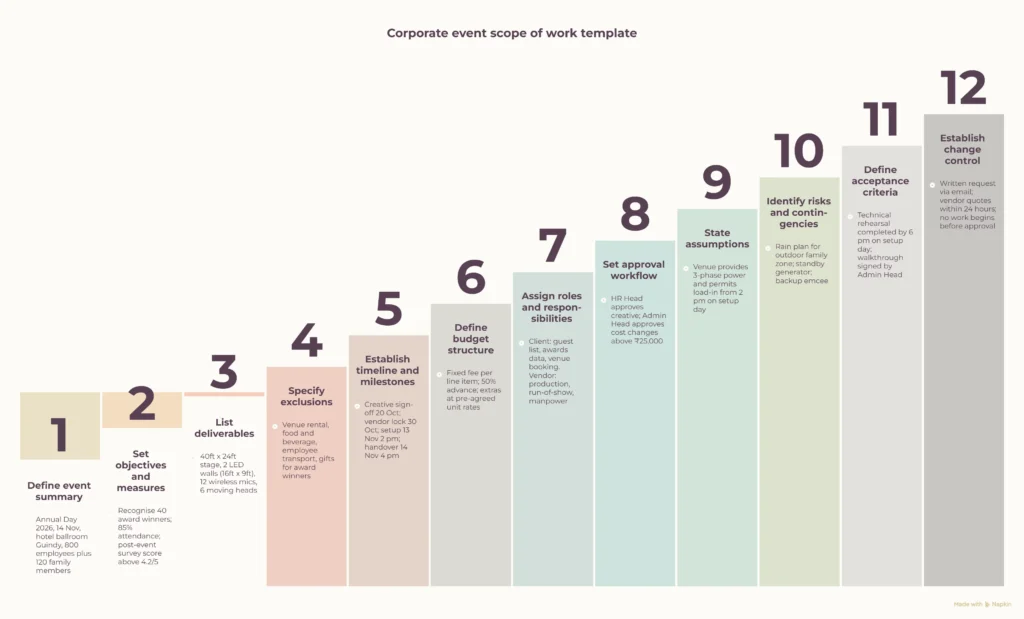
| # | Section | What it records | Example line |
| 1 | Event summary | Name, date, venue, format, expected headcount | Annual Day 2026, 14 Nov, hotel ballroom Guindy, 800 employees plus 120 family members |
| 2 | Objectives and success measures | Why the event exists and how you will judge it | Recognise 40 award winners; 85% attendance; post-event survey score above 4.2/5 |
| 3 | Deliverables | Every physical and service item, with quantity and specification | 40ft x 24ft stage, 2 LED walls (16ft x 9ft), 12 wireless mics, 6 moving heads |
| 4 | Exclusions | Items the vendor will not supply or pay for | Venue rental, food and beverage, employee transport, gifts for award winners |
| 5 | Timeline and milestones | Dated checkpoints from kick-off to post-event report | Creative sign-off 20 Oct; vendor lock 30 Oct; setup 13 Nov 2 pm; handover 14 Nov 4 pm |
| 6 | Budget structure | Cost heads, payment stages, how extras are priced | Fixed fee per line item; 50% advance; extras at pre-agreed unit rates |
| 7 | Roles and responsibilities | Who does what on both sides | Client: guest list, awards data, venue booking. Vendor: production, run-of-show, manpower |
| 8 | Approval workflow | Who signs off creative, cost changes, and final delivery | HR Head approves creative; Admin Head approves cost changes above ₹25,000 |
| 9 | Assumptions | Conditions the quote depends on | Venue provides 3-phase power and permits load-in from 2 pm on setup day |
| 10 | Risks and contingencies | Known risks and the agreed response | Rain plan for outdoor family zone; standby generator; backup emcee |
| 11 | Acceptance criteria | How the client confirms each deliverable is complete | Technical rehearsal completed by 6 pm on setup day; walkthrough signed by Admin Head |
| 12 | Change control | How scope changes are requested, priced and approved | Written request via email; vendor quotes within 24 hours; no work begins before approval |
Sections 4, 9 and 12 do most of the protective work. A scope statement guide from ProjectManager.com notes exclusions set the boundary of what the project will and will not cover, and Canva’s project scope guidance recommends listing exclusions, constraints, assumptions and dependencies together with a change control process. Event buyers usually skip all three and pay for it in October.
If you have not yet written the objectives section, our guide on how to define clear corporate event objectives walks through the difference between a goal (“celebrate the year”) and a measurable outcome (“85% attendance and 40 awards presented on time”).
The Corporate Event Scope of Work Template You Can Copy
Below is the corporate event scope of work template we share with clients during the first planning call. It is the same event scope of work structure we use internally, trimmed to fit one page. Replace the bracketed text. Delete any section you do not need, but read it first; the ones people delete are usually the ones they needed.
| CORPORATE EVENT SCOPE OF WORK | |
| Event name | [Annual Day 2026 / Dealer Meet Q3 / Plant Inauguration] |
| Client | [Company name, department, single point of contact, phone] |
| Event partner | [Event company name, project lead, phone] |
| Date and time | [Setup date and time] / [Event date, guest arrival time, close time] |
| Venue | [Venue name, hall, address, booked by client or vendor] |
| Headcount | [Confirmed number] employees + [number] guests / family / dignitaries |
| 1. Objectives | [Primary objective]. Success measured by [attendance %, survey score, leads, awards completed]. |
| 2. Deliverables | [List each item: stage size, screen size, audio spec, lighting count, decor zones, emcee, photography hours, printed items with quantities, manpower count, run-of-show document, post-event report] |
| 3. Exclusions | [Venue rental, F&B, transport, gifts, permits paid by client, overtime beyond agreed hours, items requested after freeze date] |
| 4. Timeline | Kick-off [date] · Creative approval [date] · Vendor freeze [date] · Rehearsal [date, time] · Setup [date, time] · Event [date] · Report [date] |
| 5. Budget | Total [₹]. Payment: [50% advance / 40% on setup / 10% within 7 days of report]. Extras priced at attached unit-rate sheet. |
| 6. Responsibilities | Client: [guest list, awards data, speaker slides, venue liaison]. Partner: [production, vendors, manpower, permits listed, run-of-show, safety]. |
| 7. Approvals | Creative: [name]. Cost changes above ₹[amount]: [name]. Final handover: [name]. |
| 8. Assumptions | [Venue power availability, load-in window, parking, dignitary protocol confirmed by date, content received by date] |
| 9. Risks and contingency | [Rain plan, power backup, standby talent, medical support, crowd flow for over 500 guests] |
| 10. Acceptance criteria | [Rehearsal complete by time]. [Walkthrough signed by name]. [Report delivered within days]. |
| 11. Change control | Requests in writing. Quote within [24] hours. Approval by [name] before work begins. |
| Signatures | Client: ____________ Date: ______ Event partner: ____________ Date: ______ |
Two practical notes. Attach a unit-rate sheet for common extras (an additional mic, one more hour of photography, 50 extra chairs). It removes the need to renegotiate every small addition. And put the freeze date in bold. After it, any change moves through change control, no exceptions.
How Do You Write the Exclusions and Assumptions Section?
Write exclusions by walking through the event day hour by hour and asking, for each item you see, “who pays for this and who arranges it?” Anything the event company will not own goes in exclusions. Anything the quote depends on (power, access, approvals, content) goes in assumptions. In your corporate event scope of work template, keep the two lists side by side so a reader sees the boundary in one glance. Be specific enough for a stranger to understand the boundary.
Chennai events carry a set of recurring items clients assume are included and vendors assume are not. Put each one on one side of the line before the purchase order is raised:
- Police permission, fire NOC and licensed music (PPL/IPRS) fees. State who applies and who pays. Our guide to corporate event permits in Chennai lists each approval and its lead time.
- Venue-imposed charges: in-house AV mandates, power and generator charges, corkage, extended hours, and cleaning deposits at hotels along OMR and ECR.
- Setup access. Many Chennai venues release halls only after 2 pm the day before. If your event needs crew on site at 6 am with a 40ft stage, the assumption must say so.
- Transport and parking for employees coming from industrial zones such as Oragadam, Sriperumbudur and Ambattur.
- Overtime. Manpower rates change after 10 pm. Fix the agreed hours and the overtime rate now.
- Content and data. Award winner names, speaker slides, and brand files arrive late at most companies. Assume a receipt date and state what happens if it slips.
- GST. State whether all quoted figures are inclusive or exclusive of 18% GST.
One rule keeps this section honest: for every inclusion, name the nearest thing you are not doing. If the scope says “stage backdrop printing”, the exclusion should say “venue directional signage and standees” unless you added them. If the venue is the client’s responsibility, our guide on choosing a corporate event venue in Chennai explains which venue clauses to check before you sign.
Who Is Responsible for What? The Client-Versus-Event-Company Matrix
The responsibility matrix is the section most scope documents skip and the one most disputes trace back to. The version below reflects how most Chennai corporate events split the work when the client hires an end-to-end partner. Adjust it if you keep certain items in-house.
| Task | Client | Event company | Notes |
| Event objectives and budget approval | Owns | Advises | Client decides; partner shapes scope to fit |
| Venue booking and contract | Owns or delegates | Site inspection, technical check | State clearly which party signs the venue contract |
| Creative concept, theme, stage design | Approves | Owns | Approval by named person, by dated milestone |
| Production: stage, audio, lighting, LED | Owns | Specs listed in deliverables | |
| Permits and licences | Signs applications where required | Prepares, files, follows up | Fees: state who pays |
| Guest list, invitations, RSVP | Owns | Registration desk and badges if scoped | Data must reach partner by freeze date |
| Awards data and trophies | Owns data | Trophies if scoped; sequencing in run-of-show | Late name changes are the top cause of stage errors |
| Food and beverage | Owns (usually via venue) | Coordinates timing with programme | Menu tasting, counts and cut-off dates sit with client |
| Speaker content and slides | Owns | Formats and tests on event screens | Receipt date in assumptions |
| Emcee, artists, entertainment | Approves | Owns | Contracts and riders with partner |
| Safety, medical, crowd management | Owns | Mandatory above 500 guests | |
| Photography, video, post-event report | Owns | Delivery dates in timeline |
If you are comparing vendors and are unsure what a full-service partner normally takes on, see what services to expect from a corporate event management company before you fill in this matrix.
What most companies overlook is the approval column. A scope document can list every deliverable perfectly and still fail because nobody wrote down who can say yes. On event day the HR head is with the chief guest, the admin manager is at the gate, and the vendor is waiting for someone to approve a ₹18,000 generator top-up. Name one person per decision type, give them a deputy, and put both phone numbers on the front page.
What We Have Learned from Scoping 250+ Corporate Events
At Aramm Events we write a scope document for every project, including three-day turnarounds. A few patterns repeat.
Government and defence events need the protocol section written out, not implied. For a Ministry of Defence foundation day, the scope carried a separate page on dignitary movement, seating hierarchy, security clearance windows for our crew, and who held authority to change the programme on the day. None of it was creative work. All of it decided whether the event ran on time.
Factory and plant inaugurations near Oragadam and Arakkonam taught us to scope the whole site, ceremony included. Our work on corporate event management for factory inaugurations now always records shop-floor access rules, safety induction for crew, weather cover for the pooja area, and the plant’s own power-shutdown schedule, because each one has moved a timeline at least once.
For a 6,500-student national abacus competition at Chennai Trade Centre, the scope’s most useful line was the acceptance criterion: all 6,500 seats numbered, all 40 invigilator kits placed, and the hall walkthrough signed by the organiser by 7 pm the previous evening. Because the criterion was written, the morning had no surprises.
Our recommendation, if we were scoping your event today: spend 60% of the writing time on exclusions, assumptions, and approvals. The deliverables list almost always gets written. The other three sections are where the money leaks.
Common Mistakes in Corporate Event Scope Documents
Most of these show up when a corporate event scope of work template is filled in by one side alone, or in a hurry the week before the event.
- Copying the proposal into the scope. Proposals describe possibilities. The scope must state quantities, sizes and hours.
- No freeze date. Without one, the guest count moves on the morning of the event and every vendor on site re-plans.
- Exclusions left blank because “we’ll sort it out”. PMI’s data on scope creep shows what “sorting it out” costs.
- Budget listed as a single number. Break it into cost heads so a change to one line does not reopen the whole quote.
- No acceptance criteria. “Stage ready” means different things to a client and a production manager. “Technical rehearsal completed by 6 pm, signed by Admin Head” means one thing.
- Risk section limited to rain. Power failure, artist no-show, dignitary delay, and medical incidents each need an owner and a response. Our guide on contingency planning for corporate events covers the full list.
- Scope signed by someone who cannot approve spend. Get the person who controls the budget to sign, or add them as approver in section 7.
How to Use This Template: A Five-Step Plan
- Open the corporate event scope of work template and fill in the summary, objectives and headcount before you brief any vendor. Use our questions to ask before planning a corporate event to complete this stage in one meeting.
- Send the partial scope with your brief. Ask each shortlisted vendor to return the deliverables and exclusions sections filled in. Compare those, not the creative decks.
- Agree the responsibility matrix and approvals in a 30-minute call with the chosen partner. Name people, not departments.
- Attach the budget structure and unit-rate sheet, then send the whole document to procurement with the purchase order request. Our guide to corporate event budget planning shows how to split cost heads so extras are easy to price.
- Sign, circulate to everyone with an approval role, and set the freeze date in every calendar. From the freeze date onward, every change is a written change request.
Bring Your Scope to a Partner Who Works This Way
A corporate event scope of work template does one thing well: it turns assumptions into decisions before they cost money. Fill it in once, sign it with your partner, and most event-day arguments never happen.
Aramm Events works from a signed scope on every project, whether it is an annual day for 2,000 employees, a plant inauguration in Oragadam, or a government programme with full protocol requirements. If you would like us to review a scope you have drafted, or build one with you for an upcoming event, talk to our team as a corporate event management company in Chennai or call +91 98845 22335. Send us your event date and headcount and we will return a first-draft scope within two working days.
Frequently Asked Questions
What is a scope of work for a corporate event?
A scope of work for a corporate event is a signed document listing the event’s objectives, deliverables, exclusions, timeline, budget structure, responsibilities, approvals, assumptions, risks, acceptance criteria and change process. It sets the boundary of what the event company will deliver at the agreed price.
Who should write the event scope of work, the client or the event company?
Both. The client writes the summary, objectives, headcount, budget limits and internal approvers. The event company fills in deliverables, specifications, exclusions, timeline and its own responsibilities. The final version is reviewed together and signed by both sides before the purchase order is raised.
How long should a corporate event scope of work be?
One to three pages for a single-day event, plus a unit-rate sheet. Multi-day conferences, government programmes and events above 1,000 guests often run to five or six pages because the protocol, safety and responsibility sections grow. Length matters less than specificity.
What is the difference between a scope of work and a statement of work for events?
A scope of work covers the work itself: deliverables, exclusions, timeline and responsibilities. A statement of work is the broader contract document containing the scope plus payment terms, penalties, liability, insurance and termination clauses. For a single event under a purchase order, a scope of work is usually enough.
Should the venue be included in the scope of work?
Yes, but state who books and pays for it. Many Chennai companies book the venue directly and hire the event company for production and management. The scope should record which party signs the venue contract, who liaises with the venue on power, access and F&B, and which venue charges sit outside the event company’s quote.
What are typical exclusions in an event scope of work in India?
Common exclusions include venue rental, food and beverage, employee transport, gifts and trophies, permit and licence fees, overtime beyond agreed hours, items requested after the freeze date, and GST if the quote is stated as exclusive. Each should be listed rather than assumed.
How do you handle changes after the scope of work is signed?
Through a written change request. The client sends the request by email, the event company prices it within an agreed window (usually 24 hours), and a named approver confirms before any work begins. Attaching a unit-rate sheet to the original scope makes most changes quick to price.
Do government events in Chennai need a different scope of work?
The structure stays the same but three sections expand: responsibilities (protocol, security clearance, dignitary movement), assumptions (confirmation dates for VIP attendance), and approvals (who on the department side can change the programme on the day). Most PSU and government buyers also require the scope as part of the tender response.
What should the acceptance criteria say for an event?
Acceptance criteria describe how the client confirms each deliverable is complete. Useful examples include a technical rehearsal completed by a stated time, a signed venue walkthrough, a run-of-show approved by the client, and the post-event report delivered within a fixed number of days.
Can I use this corporate event scope of work template for a product launch or dealer meet?
Yes. The 12 sections apply to any corporate format. For a product launch, the deliverables and acceptance criteria sections should add product handling, reveal sequence and media management. For a dealer meet, add registration, hospitality and travel responsibilities to the matrix.