Choosing an event agency is one of the most important decisions in the event planning process.
The right agency can help you deliver a seamless event experience, control costs, manage vendors efficiently, and achieve your business objectives. The wrong agency can lead to budget overruns, poor attendee experiences, operational chaos, and reputational damage.
Whether you are planning an annual day celebration, product launch, employee engagement program, conference, government event, or corporate gathering, using a structured evaluation framework can significantly reduce risk and improve event outcomes.
This guide provides a practical event agency selection checklist that HR teams, marketing teams, admin departments, leadership teams, and procurement professionals can use to evaluate and compare event management companies effectively.
Why Does Choosing the Right Event Agency Matter?
The right event agency reduces execution risk, improves attendee experiences, ensures budget control, and helps organizations achieve measurable business outcomes.
Many organizations focus heavily on pricing during vendor selection.
In practice, event success is often determined by planning capability, execution discipline, communication quality, vendor management, and contingency preparedness.
A professionally managed event can strengthen:
- Employee engagement
- Brand visibility
- Stakeholder relationships
- Corporate reputation
- Customer trust
A poorly executed event can create the opposite effect.
What We Have Observed
Many event failures occur not because of creative shortcomings but because of operational weaknesses such as:
- Vendor mismanagement
- Delayed timelines
- Poor communication
- Inadequate risk planning
- Lack of event-day coordination
This is why selecting the right event partner matters more than selecting the cheapest one.
What Should Be Included in an Event Agency Selection Checklist?
An effective event agency selection checklist should evaluate experience, execution capability, communication processes, pricing transparency, vendor network strength, and risk management practices.
A structured evaluation framework helps organizations make objective decisions rather than relying on assumptions or sales presentations.
The checklist should assess:
- Industry experience
- Event specialization
- Portfolio quality
- Team expertise
- Vendor management
- Budget transparency
- Communication systems
- Technology usage
- Risk management
- Post-event reporting
The 25-Point Event Agency Selection Checklist
Use this 25-point checklist to compare event management companies consistently and identify the agency most capable of delivering your event successfully.
| Evaluation Criteria | Yes/No |
| Has experience with similar events | |
| Can provide relevant case studies | |
| Has corporate event expertise | |
| Has government event experience (if applicable) | |
| Provides a dedicated project manager | |
| Offers end-to-end event management | |
| Has a strong vendor network | |
| Provides transparent quotations | |
| Clearly defines scope of work | |
| Provides detailed timelines | |
| Demonstrates risk management processes | |
| Has backup plans for critical activities | |
| Offers venue sourcing assistance | |
| Manages branding requirements | |
| Supports AV and technical production | |
| Handles logistics coordination | |
| Provides attendee management support | |
| Offers on-site event supervision | |
| Has positive client testimonials | |
| Can provide references | |
| Uses event management technology | |
| Provides regular progress updates | |
| Offers post-event reporting | |
| Maintains professional communication | |
| Aligns with your event objectives |
Organizations can score each item to create a more objective comparison process.
How Can You Evaluate an Agency’s Experience and Expertise?
Review the agency’s portfolio, event categories, client profile, industry expertise, and ability to handle events similar to yours.
Not all event management companies specialize in the same event types.
For example:
| Event Type | Experience Required |
| Annual Day | Employee engagement expertise |
| Product Launch | Brand activation expertise |
| Government Event | Protocol management expertise |
| Conference | Logistics and attendee management expertise |
| Factory Inauguration | Industrial event expertise |
Ask:
- Have you handled similar events?
- What industries do you specialize in?
- Can you share examples?
- What challenges did you overcome?
These questions often reveal more than a sales presentation.
Why Are Portfolio and Case Studies Important?
Case studies demonstrate an agency’s ability to solve real-world event challenges and deliver successful outcomes.
A strong portfolio should showcase:
- Event objectives
- Planning approach
- Execution process
- Event scale
- Outcomes achieved
Look for evidence rather than claims.
If an agency says it specializes in corporate events, it should be able to demonstrate successful corporate event execution through case studies and event documentation.
You can also review the agency’s recent projects and event gallery to assess consistency.
Internal Link Opportunity: Explore recent corporate event projects and execution examples through Aramm Events’ portfolio and event showcase pages.
How Important Is the Event Management Team?
The people managing your event matter as much as the company itself.
Before hiring an event agency, ask:
- Who will manage the project?
- Who will be present on event day?
- How large is the execution team?
- What is the escalation process?
Many organizations mistakenly evaluate only the agency brand.
In reality, event success depends heavily on the project manager and execution team assigned to the event.
How Should You Assess an Agency’s Vendor Network?
A strong vendor network improves quality, reduces risk, and increases execution flexibility.
A reliable event management company should have established relationships with:
- Venues
- Audio Visual vendors
- Stage production teams
- Entertainment providers
- Printing partners
- Fabrication vendors
- Catering partners
- Photography teams
Vendor relationships often determine event quality and responsiveness during last-minute changes.
Should Pricing Be the Main Selection Factor?
No. Pricing should be one evaluation factor, not the deciding factor.
One of the biggest mistakes organizations make is selecting an agency based solely on cost.
Instead, compare:
| Criteria | Importance |
| Experience | High |
| Reliability | High |
| Execution Capability | High |
| Communication | High |
| Pricing | Medium |
| Creativity | Medium |
| Technology | Medium |
A lower quotation may not include:
- Event supervision
- Backup resources
- Technical support
- Vendor management
- Reporting
Always compare value, not just price.
How Important Is Risk Management in Event Planning?
Risk management is one of the strongest indicators of a professional event agency.
Ask the agency:
- What happens if a vendor cancels?
- What is the backup power plan?
- How do you handle weather disruptions?
- What is the emergency escalation process?
Expert Insight
What most organizations overlook when selecting an event agency is contingency planning.
The real difference between an average agency and a professional event management partner often becomes visible when unexpected situations occur.
Professional agencies prepare for problems before they happen.
How Can You Compare Multiple Event Agencies Effectively?
Use a weighted scorecard instead of comparing agencies based on proposals alone.
Event Agency Evaluation Scorecard
| Criteria | Weight |
| Experience & Expertise | 20% |
| Execution Capability | 20% |
| Vendor Network | 15% |
| Team Strength | 15% |
| Communication | 10% |
| Risk Management | 10% |
| Pricing Transparency | 10% |
Score each agency from 1–10 in every category.
Multiply by the weighting percentage.
The agency with the highest total score should become your preferred vendor.
This approach is especially useful for:
- HR teams
- Procurement teams
- Marketing departments
- Leadership committees
What Are the Biggest Red Flags When Choosing an Event Agency?
Poor communication, vague proposals, lack of references, and unrealistic promises are major warning signs.
Watch for these red flags:
- No documented process
- No project manager assigned
- Vague quotations
- Missing scope definitions
- No client references
- Unrealistic timelines
- Poor responsiveness
- No contingency planning
- Limited portfolio evidence
- Overpromising results
If multiple red flags appear, consider other vendors.
What Questions Should You Ask Before Signing an Event Contract?
Ask questions that reveal execution capability, communication quality, and accountability.
Recommended questions:
- Have you handled similar events?
- Who will manage our project?
- What is included in the quotation?
- What is excluded?
- How often will we receive updates?
- How do you manage vendor coordination?
- What are your contingency plans?
- Can you provide references?
- What happens if timelines change?
- How do you measure event success?
- What reporting will we receive?
- How do you manage last-minute changes?
- What technology do you use?
- How many team members will be onsite?
- What support is available after the event?
These questions help uncover strengths and weaknesses before commitments are made.
How Aramm Events Approaches Corporate Event Execution
Aramm Events follows a structured, business-focused event management process designed to deliver professional execution and stress-free event experiences.
Unlike agencies that focus only on event-day activities, Aramm Events emphasizes complete ownership across the event lifecycle.
The approach includes:
- Event strategy planning
- Dedicated project coordination
- Vendor management
- Venue coordination
- Production management
- Branding execution
- Logistics support
- Risk-managed execution
- Post-event reporting
This process-driven approach helps organizations focus on attendees and business objectives while the execution team manages operational complexity.
Aramm Events specializes in:
- Corporate Events
- Annual Day Celebrations
- Product Launches
- Employee Engagement Programs
- Government Events
- Factory Inaugurations
- Conferences
If you are planning an upcoming event, you may also find these resources helpful:
- Corporate Event Management Company in Chennai
- Annual Day Event Organizer in Chennai
- Product Launch Event Management Services
- Employee Engagement Event Solutions
- Government Event Management Services
- Corporate Event Case Studies
These pages provide additional guidance and examples relevant to different event requirements.
What Should You Do Next?
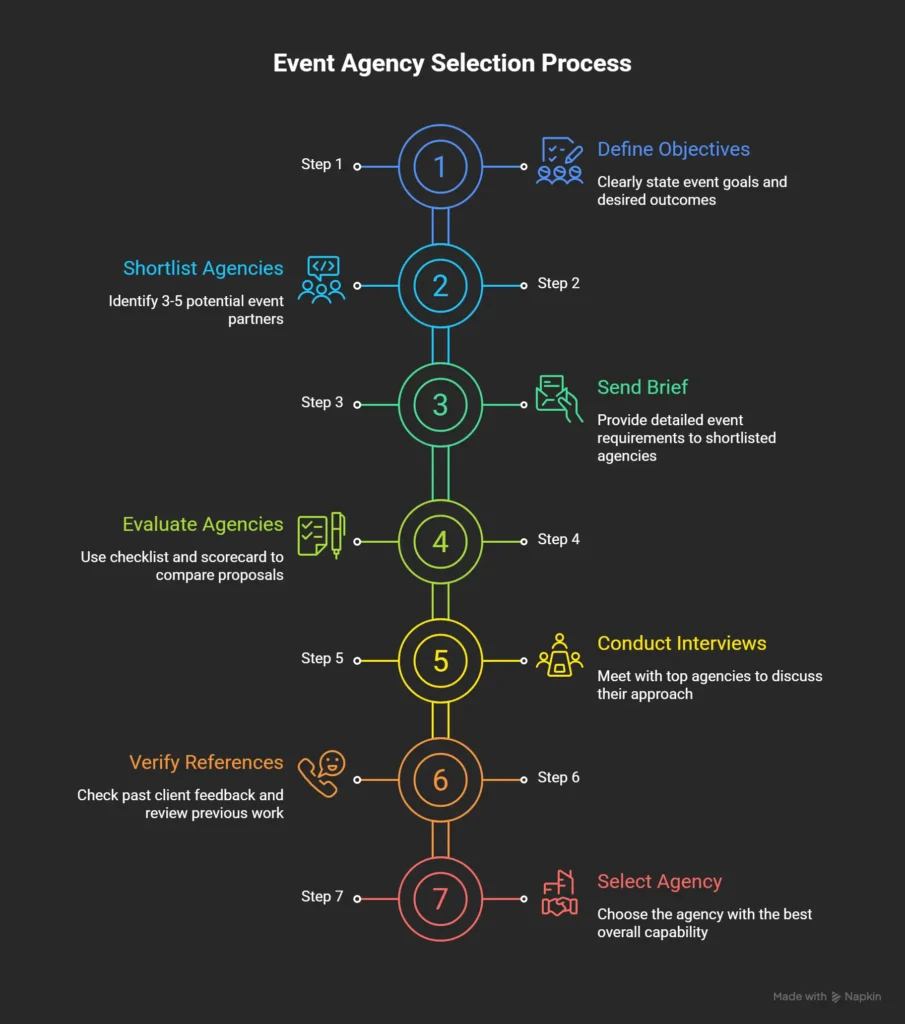
Step 1
Define your event objectives.
Step 2
Shortlist three to five event agencies.
Step 3
Send a detailed event brief.
Step 4
Evaluate agencies using the checklist and scorecard.
Step 5
Conduct vendor interviews.
Step 6
Verify references and previous work.
Step 7
Select the agency with the strongest overall capability, not simply the lowest price.
Following a structured selection process significantly increases the likelihood of a successful event.
Frequently Asked Questions
How do I choose the right event management company?
Evaluate agencies based on experience, execution capability, communication quality, vendor network strength, and risk management rather than pricing alone.
What should be included in an event agency selection checklist?
The checklist should cover experience, portfolio, team expertise, pricing transparency, vendor management, risk planning, and post-event support.
How many event agencies should I compare?
Most organizations compare three to five agencies before making a final decision.
Is experience more important than pricing?
In most cases, yes. An experienced agency can prevent costly mistakes and deliver better outcomes.
What are the biggest warning signs of a poor event agency?
Poor communication, unclear proposals, lack of references, and no contingency planning are major warning signs.
Why are case studies important when selecting an event agency?
Case studies demonstrate real-world execution capability and provide evidence of successful event delivery.
Should I ask for client references?
Yes. Speaking with previous clients can provide valuable insights into reliability and execution quality.
What is a good event agency evaluation process?
Use a weighted scorecard, conduct interviews, review case studies, verify references, and compare proposals objectively.
How important is risk management?
Risk management is critical because unexpected issues can arise during any event. Professional agencies prepare contingency plans in advance.
When should I hire an event management company?
For larger corporate events, it is advisable to engage an agency several months in advance to allow sufficient planning and coordination.
Need Professional Event Management Support?
Planning a corporate event, annual day celebration, product launch, conference, employee engagement program, or government event?
Aramm Events helps organizations execute stress-free events through structured planning, professional coordination, and reliable execution.
Because successful events don’t happen by chance. They happen through planning, coordination, and execution.